- The Profit Insider
- Posts
- Strategy: The $400B Content Party You're Missing 🎉
Strategy: The $400B Content Party You're Missing 🎉
10X Your Business With This B2B Content Strategy That Actually Works

Priyabrata Goswami
October 25, 2024
Estimated Read Time: 6 Minutes 24 Seconds ('“Trust Me Bro” I know that I promised 3-5 Minute Insight, But The Extra Time Is Worth It)
[Click on the top right ‘Read Online’ to get a better reading experience]
Wassup,
Happy Friday.
For today’s discussion, let's talk about B2B content strategy
You know, that thing everyone claims to be doing but secretly feels like they're just throwing spaghetti at a digital wall. 🍝
Fun fact: Companies worldwide spent a whopping $400B on content marketing last year. That's enough money to buy Netflix (and still have enough left over for a lifetime supply of coffee to fuel your content team! ☕).
But here's the kicker - 70% of companies feel like they're getting about as much ROI as a chocolate teapot. Let's fix that, shall we?
The B2B Content Party: Who's Actually Having Fun? 🎯
Remember when everyone said "content is king"? Well, they forgot to mention that content without strategy is like bringing a kazoo to a rock concert
- technically it's an instrument, but probably not what your audience was hoping for. 🎸
Here's what's really happening in the B2B content world:
7 million blog posts are published daily (most with the excitement level of watching paint dry)
67% of B2B buying happens digitally (because who needs human interaction anymore, right?)
Most content strategies are about as focused as a puppy in a squirrel sanctuary 🐿️
Let's dive into what actually works (no fluff, just the good stuff).
The "Oh-That's-Why-It-Works" Framework 📈
Think of your content strategy like a Netflix series (stay with me here). You need:
A killer pilot episode (top-of-funnel content)
Character development (nurturing content)
A satisfying season finale (conversion content)
And absolutely no Game of Thrones season 8 moments (trust me on this one😅)
Level 1: The "Wait, What?" Stage
(AKA The Unaware Stage)
Your audience here is like someone who's never heard of coffee (poor souls). They don't know they have a problem, let alone that you have a solution.
Content Ideas:
"Why [Industry] Leaders Are Losing Sleep (Besides Their Coffee Addiction)"
"The Future of [Industry] (Spoiler: It's Not Flying Cars)"
Pro Tip: This audience is larger than your ex's ego - about 60-70% of your total market.
Level 2: The "Houston, We Have a Problem" Stage
(AKA Problem Aware)
These folks are like someone who knows they need coffee but haven't discovered espresso yet. They know something's wrong but aren't sure what to do about it.
Content Ideas:
"Is Your [Business Process] a Dumpster Fire? Here's How to Tell 🔥"
"5 Signs Your [Solution Area] is Crying for Help"
Level 3: The "Shopping Around" Stage
(AKA Solution Aware)
These people are like someone in a coffee shop staring at the menu for 10 minutes. They know solutions exist but are suffering from choice paralysis.
Content Ideas:
"Comparing [Solution] Options (Without Falling Asleep)"
"The Only [Solution] Guide You'll Need (Until We Update It Next Week 😉)"
Level 4: The "Almost There" Stage
(AKA Product Aware)
They're window shopping your product like it's the last PS5 before Christmas. They know about you but need that final push.
Content Ideas:
"Why [Your Product] vs [Competitor] is Like Comparing a Smartphone to a Potato"
"ROI Calculator (For Those Who Actually Like Math)"
Level 5: The "Take My Money" Stage
(AKA Most Aware)
These beautiful people know your product better than their spouse's birthday. They just need the final nudge.
Content Ideas:
"Secret [Product] Features That'll Make You Feel Like a Wizard 🧙♂️"
"Advanced Tips (That Won't Break Everything)"
The Content Cluster Strategy (Or: How to Make Google Love You) 🎯
Think of your content like a Marvel movie universe - everything's connected, and there's always a post-credits scene. Here's how to structure it:
Main Topic (Your Avengers)
│
├── Pillar Content (Your Iron Man)
│   ├── Subtopic 1 (Captain America)
│   ├── Subtopic 2 (Thor)
│   └── Subtopic 3 (Black Widow)
│
├── Supporting Content (The TV Shows)
    ├── Case Studies (WandaVision)
    └── How-To Guides (Loki)
Metrics That Actually Matter 📊
(Because Not Everything Needs to Be Measured, Karen)
Engagement Metrics
Time on Page (longer than a TikTok video)
Scroll Depth (beyond the first gif)
Return Rate (like your favorite coffee shop)
Lead Metrics
Conversion Rate (higher than your dating app success rate)
Lead Quality (better than those LinkedIn connection requests)
The "Actually Do This Now" Action Plan 🎯
Let's get super practical about where to start. Because let's face it - if you're like most founders, you've got about 47 browser tabs open right now and you need someone to tell you exactly what to do next.
Step 1: The Customer Check ✋
Before you write a single word, ask yourself:
Do you have at least 10 customers? If not, STOP RIGHT HERE!
Seriously, if you're pre-10 customers, close this email and go do some cold outreach instead. Content marketing can wait - you need faster wins right now.
Your mission: Get those first 10 customers through direct outreach, forums, ads, or whatever gets results NOW.
Step 2: Pick Your Battle Station 🎪
If you've got those 10+ customers, here's exactly where to focus:
Start Here (Your Money Zone):
Solution-Aware Content
Create comparison lists: "Top 5 [Solutions] for [Specific Problem]"
Industry guides: "Best [Solution] for [Industry]"
Pricing comparisons: "Budget-Friendly [Solutions] Compared"
Product-Aware Content
Write "Alternative to [Big Competitor]" pieces
Create detailed comparison pages
Build feature-specific landing pages
Don't Start Here (Seriously, Don't):
Unaware content (those "how to be better at business" posts)
Problem-aware content (too early in the funnel)
Most-aware content (save the expert stuff for later)
Step 3: The Content Creation Sprint 🏃♀️
Week 1:
List your top 3 competitors
Create one "Alternative to [Competitor]" page for each
Expected time: 2-3 hours per piece
Week 2:
Identify top 5 industry solutions
Create one comprehensive comparison guide
Expected time: 4-5 hours
Week 3:
Pick your top 3 product features
Create detailed landing pages for each
Expected time: 2 hours per page
Week 4:
Set up basic tracking (Google Analytics is fine)
Monitor which pieces get traction
Double down on what works
Now that you have everything set up, Publish a few content pieces for people on Solution Aware and Problem Aware stages every week.
The "Don't Make These Mistakes" Checklist 🚫
The "Spray and Pray" Trap
DON'T: Write about every topic in your industry
DO: Focus only on solution and product-aware content initially
The "Too Much, Too Soon" Error
DON'T: Try to create content for all awareness levels
DO: Start with comparison and alternative pages only
The "Traffic Over Conversion" Mistake
DON'T: Chase high-volume, low-intent keywords
DO: Target people actively looking for solutions
ROI Timeline Expectations 📅
Month 1-2: Setup and creation
Month 3-4: Initial rankings
Month 5-6: First conversion signals
Month 6-8: Consistent leads (if you did it right)
Remember: Content marketing is like planting a garden - you don't get tomatoes the day after you plant the seeds. But unlike actual gardening, you can't kill your content by forgetting to water it. 🌱
What's Hot in 2024 🔥
AI Content Tools (that don't sound like robots with a thesaurus)
Video Content (TikTok, but make it B2B)
Interactive Content (because clicking buttons is fun)
The "You've Got This" (Conclusion) 🎬
Remember: Great B2B content is like a good coffee shop - it attracts the right people, serves something valuable, and keeps them coming back for more. Also, pumpkin spice everything is optional.
Got questions? Hit reply! I promise to respond faster than your IT department.
Stay awesome,
P.S. If you made it this far, you deserve a cookie 🍪
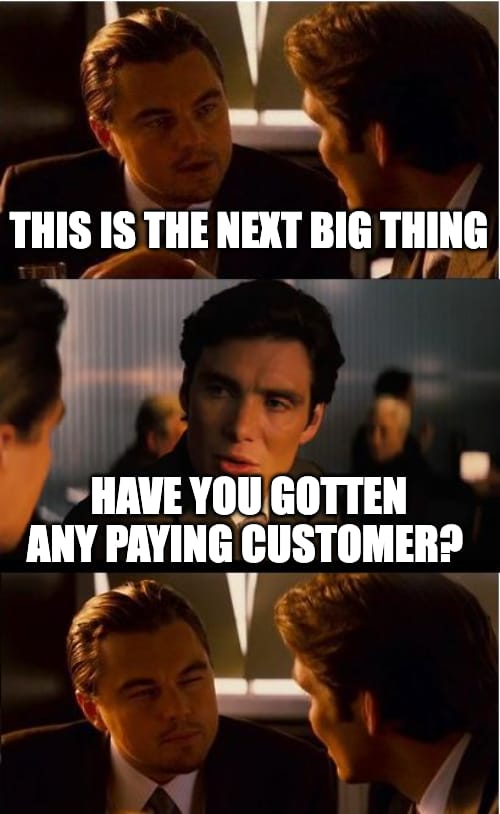
Meme Of The Day 😂: